
Why Your Horse Trailer's Stall Width Shouldn't Be One-Size-Fits-All
A 15-hand quarter horse and an 18-hand warmblood are not the same animal, and yet a lot of trailers put them in the same width stall. That's not a small oversight. A 2020 study published in the peer-reviewed journal Animals put a number on exactly how much stall width affects a horse's ability to balance during transport, and the underlying lesson wasn't really about picking the "right" width. It was that there isn't one right width at all. It depends on the horse.
The short version: horses in wider stalls (about 39-44 inches) lost their balance roughly a third as often as horses in narrower stalls (about 30 inches). Loss of balance during transport is also one of the strongest predictors of gastric ulceration afterward. A fixed stall width can't serve every horse equally, which is why stall width should be a measurement fit to the horse, not a default spec.
What the Study Found
Researchers Barbara Padalino and Sharanne Raidal transported 26 mares on a 12-hour overnight journey, comparing horses in standard single bays (76cm, about 29.9 inches wide) against horses in wider bays (100 to 112cm, about 39.4 to 44.1 inches wide). Horses in the wider bays lost their balance roughly a third as often as horses in the narrow bays, about 6.6 events per 20 minutes compared to 19.9, and showed less leaning on partitions, less restless stepping, and fewer stress behaviors overall.
The researchers called this the actual novel contribution of the study: real animal-based evidence that stall width measurably changes a horse's ability to balance in transit.
Why Does Stall Width Actually Affect Balance?
It comes down to how a horse's body works. To stay balanced while a trailer accelerates, brakes, and turns, horses naturally widen their stance, spreading their front and hind legs apart with the forelegs stretched forward, using that wider base to shift weight as the vehicle moves. That posture is well documented in the research this study builds on. The problem is obvious once you see it: a horse can't adopt that stance if there isn't room on either side of its body to do it.
There's a second piece to this. On longer journeys, horses also benefit from being able to lower their head below the height of their withers, a posture linked to better respiratory and overall wellbeing on trips over 8 hours. That posture requires its own kind of space, and in a stall that's genuinely too narrow, a horse may not have the room to do either thing comfortably.
So "more room to balance" isn't a vague comfort claim. It's specifically room to do the two things a horse's body actually needs to do in order to manage a moving trailer well.
Why This Matters Beyond Comfort
Loss of balance wasn't just a behavioral footnote. It turned out to be one of only three significant predictors of clinically significant gastric ulceration after transport, alongside changes in heart rate and rectal temperature. The correlations were substantial: loss of balance was strongly linked to the change in a horse's heart rate (r = 0.59) and rectal temperature (r = 0.76) after the trip, two of the strongest correlations found anywhere in the study.
One number is worth sitting with. In the study's regression analysis, each one-degree increase in rectal temperature after transport raised the odds of developing clinically significant gastric ulceration by a factor of 5.4. Balance, body temperature, and ulcer risk are not separate issues in this data. They move together.
Signs Your Horse May Not Have Enough Room
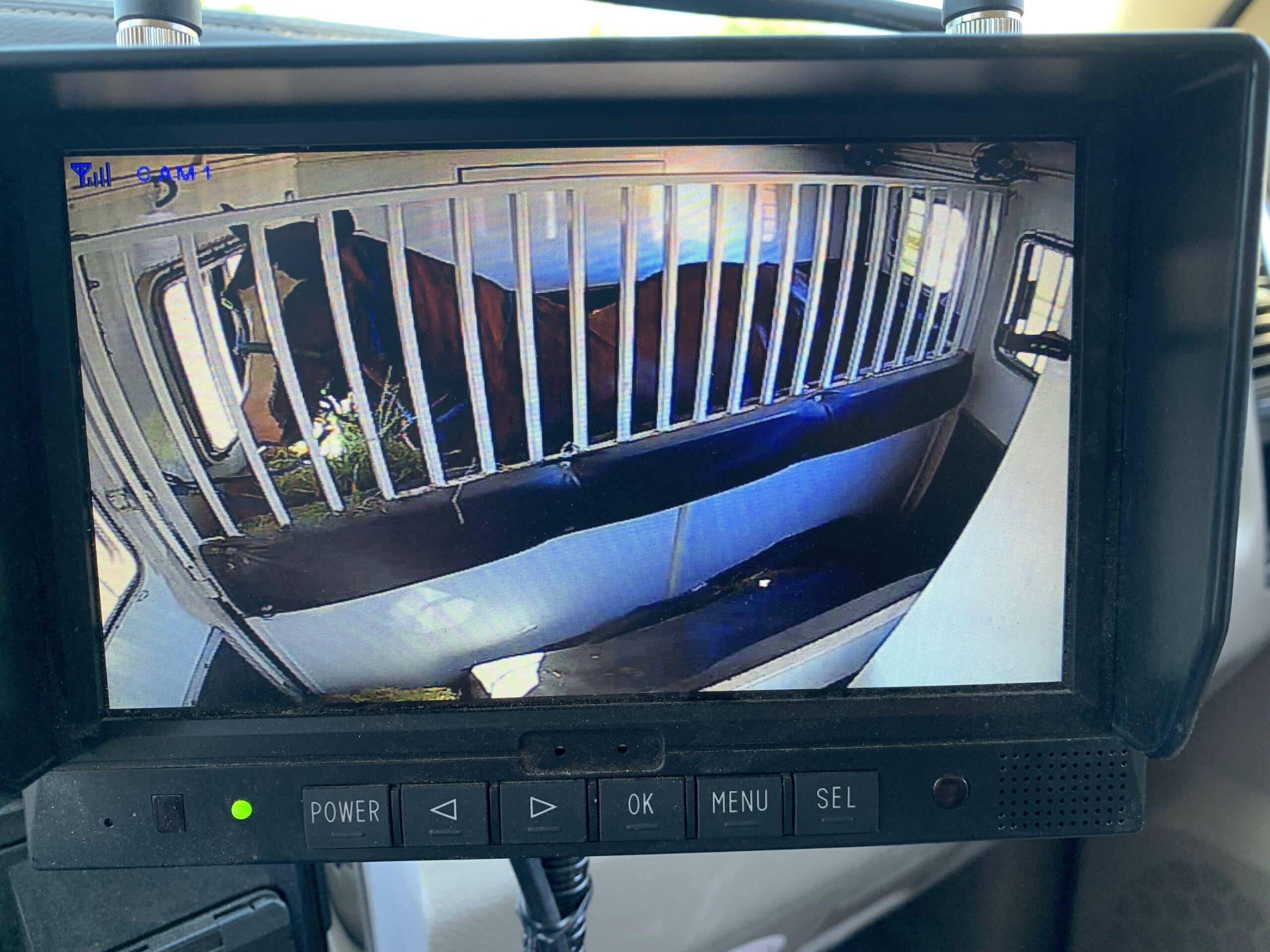
The researchers tracked a specific set of behaviors to measure how well a horse was managing its balance in transit. They're worth knowing, since they translate directly into things you can actually watch for on your own hauls, especially if you run a camera in your trailer:
- Leaning on the stall rails or partitions: using the wall for support rather than its own stance
- Frequent forward, backward, or lateral stepping: constantly readjusting footing rather than settling
- Touching or fidgeting with the tie: a documented redirected behavior linked to elevated stress in this research
- Visible loss of balance: stumbling into or bumping a partition, the clearest sign of all
None of these are dramatic on their own. A horse doing one of them occasionally isn't cause for alarm. But a horse doing several of them consistently, trip after trip, is showing you something concrete: not enough room to manage its own balance.
The Real Lesson Isn't "Wider Is Better." It's "Fit Matters."
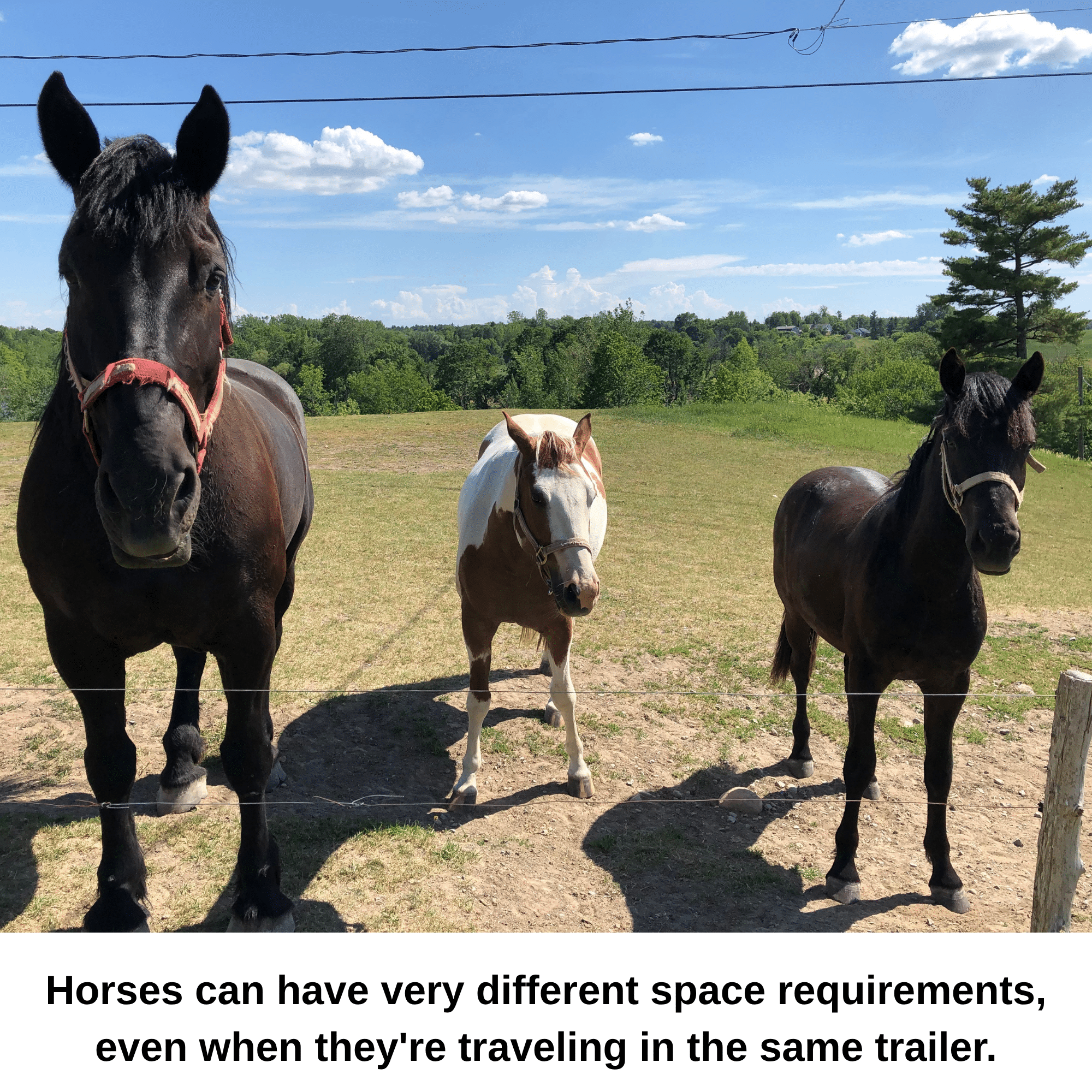
Here's the thing a single study comparing two fixed widths can't tell you: a stall wide enough for a compact 14.2-hand pony is not wide enough for an 18-hand draft cross, even though both would technically be riding in the same "wide bay" category. The study's own design, testing one width against another, actually illustrates the underlying problem: any fixed stall width is going to be generous for some horses and tight for others. The only way to actually solve for balance and comfort across a range of horse sizes is to stop treating stall width as a fixed spec and start treating it as a measurement that should change with the horse standing in it.
This is really a buyer-education point more than a product spec. Whatever trailer you're considering, from whatever manufacturer, the question worth asking directly is whether the stall width can be built to your horse's actual size, or whether you're being offered one default width regardless of whether your horse is 14 hands or 18.
How Much Stall Width Does Your Horse Actually Need?
There's no published formula converting hand height directly into inches of stall width, and it's worth being honest about that rather than inventing a precise-sounding number the research doesn't actually support. What the research does support is the underlying principle: a horse needs enough lateral room to widen its stance and shift weight without its body touching the walls on either side.
In practice, that means body width matters more than height alone. A stocky, heavily-muscled horse and a narrow-bodied horse of the same hand height don't need the same amount of stall width, the same way two people of the same height can need different amounts of legroom in a car seat. A horse's actual measurement across the widest part of its body, typically through the point of the shoulder or the barrel, standing normally, is a more useful starting point than hand height by itself. From there, the practical goal is clearance on both sides of that measurement, not a snug fit to it.
This is exactly why a fixed stall width is a compromise no matter what number a manufacturer picks: it's solving for an average horse that, in practice, doesn't exist.
A Practical Note: How to Actually Measure Stall Width
This matters even more once you start comparing custom options, because two numbers that look similar can mean very different things:
- Exterior box width isn't stall width. A trailer's total exterior width (capped at 102 inches for legal road width) tells you nothing about how much room an individual horse has once dividers and walls are accounted for.
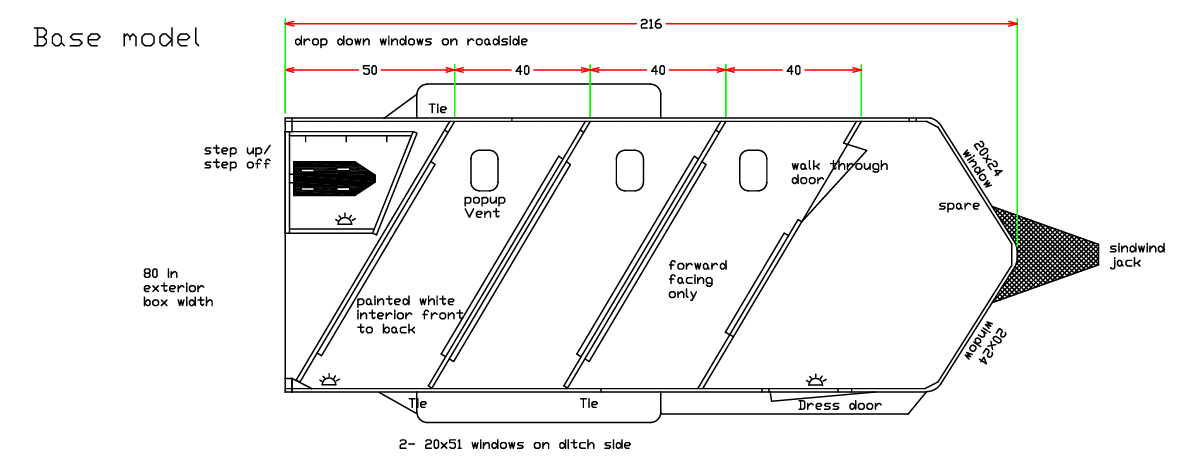
- In a slant-load trailer, the diagonal measurements on a floorplan aren't the horse's actual side-to-side room. The partitions run at an angle, so a length measured along that angle is longer than the straight-line width the horse's body actually occupies. The number that matters is the perpendicular distance between the two partitions of a single stall, not the diagonal.
How Double D Trailers Approaches This
We size every trailer to the horse it's carrying rather than defaulting to one width for every build. A standard 2-horse straight-load stall is 36 inches per horse. A standard slant-load has a 40" stall size, equates to about 31" at the horses belly. For larger horses, slant-load stalls can be built out to 55 inches.
That customization also isn't locked to a single width across the whole trailer. Each stall is sized individually, so a 4-horse trailer hauling four different-sized horses doesn't have to compromise around whichever one is biggest, or force the smallest horse into more room than it needs. If you've got a pony, two mid-size horses, and an 18-hand warmblood all traveling together, each of those four stalls can be built to that specific horse. None of that is an upgrade tier bolted onto a base model, it's the standard answer to the question this research actually raises: what does this specific horse need?
The Bottom Line
Stall width isn't just a comfort preference, and it isn't a spec you should have to accept as fixed. It's one of the few trailer measurements with real evidence tying it to a horse's physical ability to balance, and that balance is tied to real health outcomes, including a meaningfully higher risk of gastric ulceration. When you're evaluating any trailer, ask for the straight-line stall width, measure your own horse's body width rather than relying on hand height alone, and ask whether the trailer can be built to your horse rather than the other way around.
This article is part of our series on horse trailer safety. For a broader look at what to evaluate before you buy, see our prevention guide.
FAQ: Horse Trailer Stall Width
Why shouldn't stall width be a fixed, one-size-fits-all spec? Because horses vary enormously in size and body type. A width that's generous for a 14.2-hand pony can be genuinely tight for an 18-hand horse. A 2020 peer-reviewed study found that horses in narrower stalls lost their balance roughly three times as often as horses in wider stalls.
Why does extra stall width actually help a horse balance? Horses naturally widen their stance and shift weight through their legs to stay balanced in a moving trailer, and on longer trips they also benefit from lowering their head below wither height. Both of those natural balancing behaviors require lateral room a narrow stall doesn't provide.
Is loss of balance during transport actually a health risk, or just a comfort issue? Both, and more seriously than most owners realize. The same study found loss of balance was one of the strongest predictors of gastric ulceration after a long transport, and each one-degree rise in rectal temperature after a trip raised the odds of clinically significant ulceration by a factor of 5.4.
What behaviors suggest a horse doesn't have enough stall width? Leaning on the partitions, frequent forward/backward/sideways stepping, fidgeting with the tie, and visibly losing balance against the walls. Occasional instances aren't alarming, but a horse doing several of these consistently is showing a real space problem.
How do I know the real stall width of a trailer I'm considering? Ask for the straight-line width between a single stall's two partitions, not the trailer's total exterior width and not a diagonal measurement from a slant-load floorplan. Those numbers can look similar but measure very different things.
How much stall width does my horse actually need? There's no exact published formula, and the honest answer depends on your horse's actual body width, not just its hand height. Measure across the widest part of the body (shoulder or barrel) while standing normally, then look for clearance beyond that on both sides.
What should I ask a manufacturer about stall width? Whether the stall width is fixed or can be built to your horse's actual size. A trailer that only comes in one width is making that decision for your horse instead of you.
Can different stalls in the same trailer be different widths? They can, if the manufacturer builds each stall individually rather than stamping every stall from the same mold. That matters if you're hauling multiple horses of different sizes together, since it means the trailer can fit each horse rather than compromising around whichever one is largest or smallest.
Study: Effects of Transport Conditions of Behavioral and Physiological Responses of Horses